The COMPETE Act Would Hold Dominant Entertainment Companies Accountable for Anticompetitive Conduct
04. 03. 2026

The COMPETE Act (AB 1776) would, for the first time, give California a clear statutory prohibition on monopolization, monopsonization, and restraints of trade by a single dominant firm, bringing our state in line with the large majority of states and making it harder for dominant studios, streamers, and distributors to use exclusionary contracting, self-preferencing, or buyer power to lock out rivals and talent and increase prices.
Dominant firms in the entertainment industry use their market power to squeeze creators, undercut workers, and jack up prices for consumers
In the 1980s, when more than 50 companies competed in film and television production, California’s entertainment industry functioned as a broad-based economic engine. Competition among studios and distributors expanded opportunities for creative workers, supported independent and mid-sized businesses, and sustained investment across production and related industries statewide. Today, a handful of media conglomerates determine the media Californians consume and how much they pay. Four dominant streamers—Amazon, Netflix, Disney, and Max—control 79% of the TV streaming market, and prices keep rising.
As Governor Newsom recently remarked, “Consolidation in markets at the center of American economic life—like the entertainment or broadcasting industries—doesn’t serve our economy and has proven to lead to increased unaffordability, a loss of good-paying job opportunities, and fewer choices for consumers.”
FIG. 1. STREAMING TV PRICES HAVE INCREASED SHARPLY WHILE TELECOMMUNICATIONS INDUSTRY PRICES HAVE REMAINED RELATIVELY FLAT
Indexed BLS CPI for cable, satellite, and live streaming television services and BLS PPI for the telecommunications industry (Jan 2015 = 100)
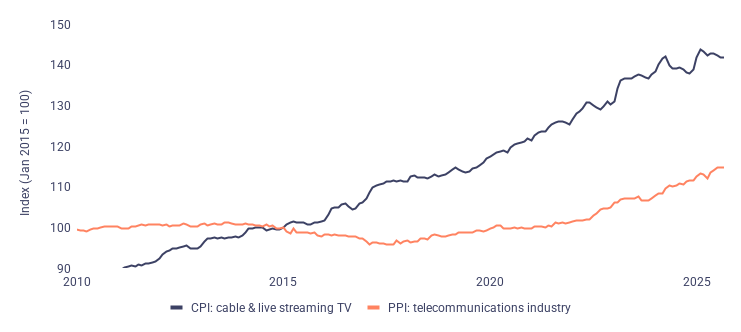
Without legislation to rein in unchecked anticompetitive conduct by dominant firms, troubling trends will continue:
People of color and new and smaller creators will be locked out. Concentrated control shifts investment away from underrepresented creators, with dominant firms opting instead for content libraries that favor incumbents and proven franchises, crowding out investment in creators from underrepresented communities.
Consumers will pay higher prices, exacerbating the already dire affordability crisis. Since 2019, as competitive pressure has weakened and platforms consolidate content and distribution power, major streamers have increased prices by up to 172%. Without competitive pressure, dominant firms can raise prices as much as they want—even in the absence of changes in the cost of delivering the service.
Independent movie and television show creators will be shut out, reducing industry dynamism and innovation, and hampering California’s ability to compete globally. When one company controls multiple stages of the pipeline (vertical integration)—e.g., making movies and television shows, distributing it, and deciding how audiences access it—it can push its own content and shut out smaller creators, reducing competition and innovation.
Jobs will be fewer and farther between, and will pay less. The research is clear: antitrust enforcement increases employment and wages; labor markets with higher concentration are linked to higher unemployment and lower wages.
Consumers will have less choice and less diverse content to choose from—essentially poorer products for a higher price. Concentration of ownership among media companies reduces the range of viewpoints and content diversity available to the public, because fewer owners means fewer independent decisions about what gets made and promoted. A single vertically integrated company—one that owns both the pipes and the programming—can shut out rivals in commerce and in public discourse alike.
The COMPETE Act would restore fair competition by holding single dominant firms accountable for harmful conduct by:
- Closing the single-firm loophole by making it clear that anticompetitive conduct by a monopoly is just as illegal as collusion by multiple companies.
- Holding gatekeepers accountable by prohibiting a single firm from restraining trade, such as when a dominant platform blocks competitors from reaching customers, or uses its power in one market to squeeze out rivals in another.
- Protecting workers and suppliers by explicitly covering monopsony—when a dominant buyer uses its market power to suppress wages or squeeze the businesses that sell to it. When a handful of companies control the market for buying creative work, they can drive down compensation even as their own profits grow.
- Clarifying that California courts are not bound by federal cases that are inconsistent with California’s goal of “maximally” protecting competition, including by enabling courts to take a holistic approach to curbing anticompetitive harm.