Affordability
Restoring Competitive Markets for Workers, Consumers, and Small Businesses
04. 22. 2026
Part of the 2026 Economic Security California Action Policy Agenda

Healthy competition is what keeps corporate power in check. In market after market in California, it’s been hollowed out. When corporations control a market and lock out rivals, they can charge what they want and pay what they want, because no one has anywhere else to go. The result is a direct transfer of wealth from household budgets to corporate coffers, CEOs, and shareholders: concentration costs California families $3,700 a year in excess costs above what competitive markets would charge. Prices continue to soar on everything people need: from 2020 to 2024, the cost to feed a family grew 2.5 times faster than inflation, while corporate profits rose five times faster. Median S&P 500 CEO pay reached $17.1 million in 2024, while real wages grew only 2.9% since the pandemic. A driving factor in this imbalance is the anticompetitive conduct of the large corporations that control virtually every sector of the economy. Concentrated market power drives and maintains California’s affordability crisis, and nowhere in the country is it more entrenched than here. The same firms generating record profits are extracting higher prices, paying lower wages, and offering fewer choices to the 39 million people who power this economy. The existing guardrails are not holding up.
Broken Markets: California is Ground Zero for Corporate Concentration
California is home to 58 Fortune 500 companies and 33 of the world’s 50 leading AI companies. The corporations that set prices, wages, and market terms for millions of Americans make their decisions here. Across sector after sector, markets that were once competitive have become dominated by a handful of firms. That also means California is uniquely positioned to act: the state that hosts the world’s most powerful corporations has both the standing and the leverage to demand they compete fairly.
Unchecked market power costs Californians in higher prices, lower quality, and fewer choices. When a small number of corporations control a market instead, they can charge more, deliver less, and face no accountability because consumers have nowhere else to go. The evidence is everywhere: three health insurers control 80% of California’s market, and hospital prices have risen 600% in 35 years. Four companies control up to 85% of meat processing, and the prices families pay for chicken and beef no longer reflect production costs. Broadband prices in the U.S. are roughly double what consumers pay in peer nations. The same dynamic plays out in labor markets. When a few large employers dominate local hiring, workers lose the bargaining power that comes from having real options, and wages end up roughly 20% lower than they would be in a competitive market.
Corporate dominance is self-reinforcing: the more control a firm has, the more tools it has to ensure no rival can realistically compete. The strategy is straightforward: buy up potential rivals before they can grow, lock suppliers and customers into exclusive arrangements, and use control over essential infrastructure to favor their own products over everyone else’s. The five biggest tech companies acquired 819 smaller firms in a single decade to eliminate competition before it could threaten them. For the small businesses and startups that depend on dominant digital platforms to reach customers, the terms are increasingly punishing: platform fees that take up to half of every transaction leave independent businesses competing on a playing field designed to put them out of business. California’s once-vibrant entrepreneurial ecosystem reflects the result. In the 1980s, roughly 90% of venture-backed startups exited via an IPO, and 10% via acquisition. By 2019, that ratio had flipped: about 90% exited through acquisition by a larger firm.
The Affordability Agenda: Fair Markets Are Good Business, and Modern Laws Make Them Possible
For the first time in a century, California is positioned to strengthen its core antitrust law to protect consumers, workers, and small businesses from anticompetitive conduct that crushes competition, keeps wages down, and drives up prices. Stronger rules against monopoly abuse and restraints of trade create more opportunities for entrepreneurs and workers and lower prices for everyone.
What’s Working: A Clear Path Forward and Growing Momentum
California isn’t starting from scratch. Over the past several years, the state has passed landmark legislation, secured major enforcement victories, and launched the most comprehensive expert review of its antitrust laws since the Cartwright Act was enacted in 1907. The path forward is clear.
California has shown that markets can be shaped through a mix of investment and regulation. The state has taken on pharmaceutical monopolies directly: CalRx, the state’s initiative to develop and sell its own generic drugs at cost, biosimilar insulin available to Californians a fraction of current market prices, and recently passed legislation has reined in price gouging by pharmacy benefit managers. The Office of Healthcare Affordability has extended that logic to mergers, requiring healthcare entities to notify the state before closing acquisitions. This gives California advance review authority over consolidations that concentrate market power and drive up costs. California has brought the same approach to tech by establishing CalCompute, a public cloud computing cluster, and becoming the first state in the nation to ban algorithmic price fixing. These wins are proof of concept for what modern market oversight looks like.
The legislative groundwork for the next phase is already before the legislature. After years of rigorous expert analysis, the California Law Revision Commission has produced its first recommendations, starting with closing the single-firm conduct gap in the Cartwright Act to give California its own independent tools to address monopoly abuse and restraints of trade by a single firm. That recommendation is now before the legislature as the COMPETE Act (AB 1776 – Aguiar-Curry). The legislature is also considering the BASED Act (SB 1074 – Wiener) to stop dominant platforms from rigging digital markets in favor of their own products, and the Surveillance Pricing Protection Act (AB 2564 – Ward) to prohibit corporations from using personal data to extract maximum prices from individual consumers.
California has proven it can take on dominant corporations and win. In recent years, the State has secured a string of significant enforcement victories. California’s Attorney General joined the federal DOJ in the suit that found Google unlawfully monopolized publisher ad servers and ad exchanges. The Attorney General joined the FTC in successfully blocking the $24.6 billion Kroger-Albertsons merger, preventing a consolidation that would have increased grocery prices and weakened workers’ bargaining power. California has also joined a coalition of states suing Live Nation and Ticketmaster for monopolizing the live music market. When the federal government settled for terms that fell far short of breaking up the monopoly, California and a coalition of states rejected the deal and are moving forward with the case. And after 25 years of dormancy, California is reviving criminal antitrust enforcement: the California Department of Justice has announced it will resume prosecuting cases, and the legislature increased the maximum criminal fines sixfold to $6 million per violation, signaling that the state is done treating antitrust violations as routine cost-of-doing-business settlements.
What’s Broken: Dominant Corporations Exploit Laws the Rest of the Country Has Already Fixed
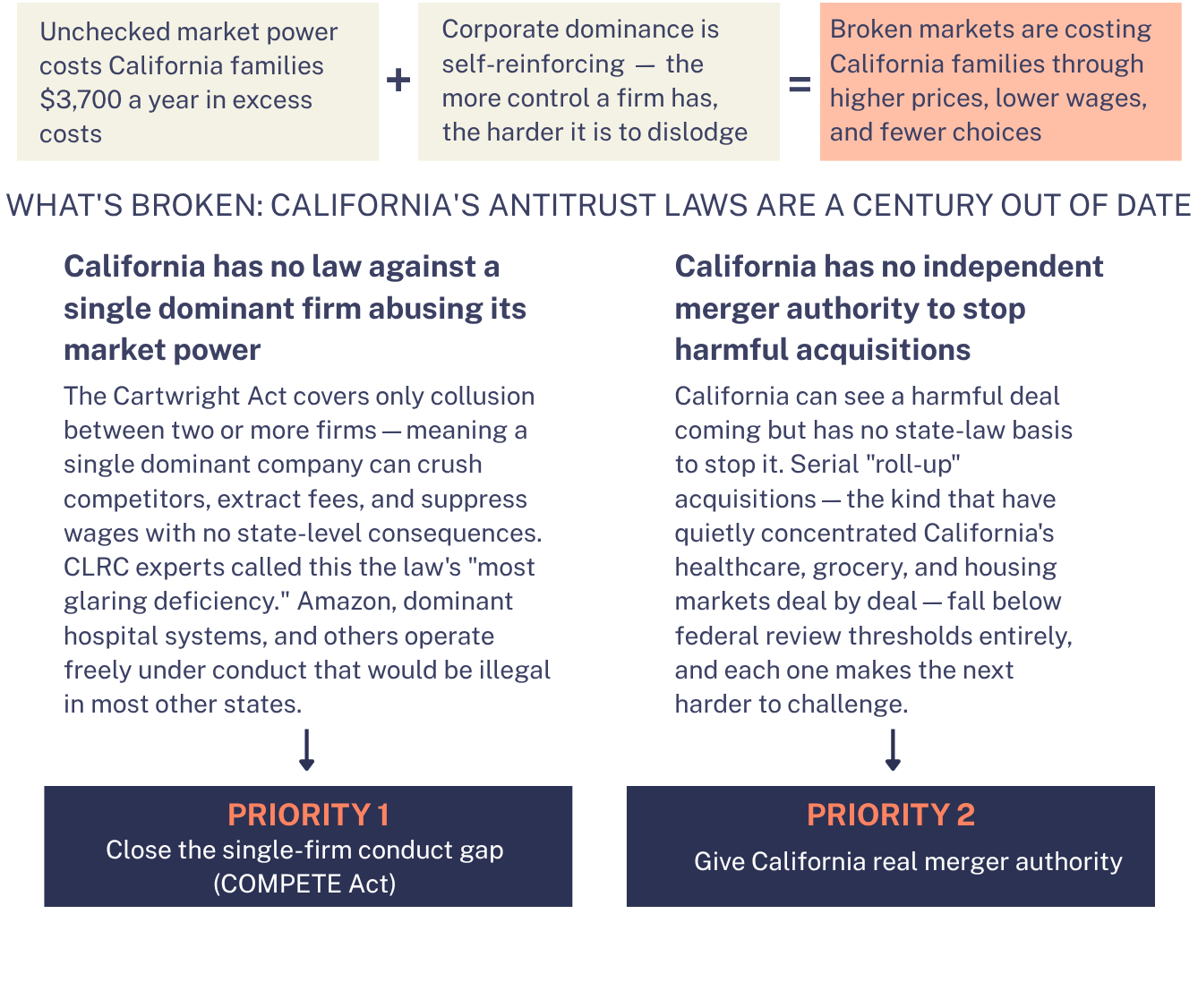
California is one of only a handful of states with no law against a single dominant firm abusing its market power. The Cartwright Act is California’s foundational antitrust statute, enacted in 1907. It prohibits anticompetitive conduct between two or more firms, but says nothing about what one dominant firm can do on its own. CLRC experts called this the Cartwright Act’s “most glaring deficiency.” Under current California law, conduct by a single dominant firm cannot be challenged as a state antitrust matter, whether it’s Amazon charging sellers nearly half of every dollar in fees to access marketplace infrastructure it controls, or a dominant hospital system that refuses to contract with an independent physician group to eliminate a competitor. Federal law theoretically covers some of it (under the Sherman Act), but decades of judicial interpretation have diminished its effectiveness, and federal enforcement under the current administration is unreliable. Meanwhile, many of the corporations doing the most damage are headquartered in California, and the state needs its own independent tools to stop them.
California likewise has no merger law of its own. California law has no statutory provision allowing the state to review or challenge acquisitions, and our Attorney General must fight harmful deals in federal court under a precedent the state had no hand in shaping. The legislature recently took a first step with the passage of SB 25, requiring the state Attorney General to receive federal Hart-Scott-Rodino (HSR) filings, the notices companies must submit before closing large deals, at the same time as federal regulators. But it is a notification statute, not an enforcement one: California can see a deal coming and still has no independent state-law basis to stop it. Worse, these federal HSR filings are only required for mergers above $133.9 million, meaning the smaller serial acquisitions that have often concentrated California’s healthcare, grocery, and housing markets never triggered federal review at all. Each of these “roll-up” deals makes the market more entrenched, in some cases resulting in near monopoly control in regional markets, and raises the baseline concentration that enforcers must clear to show the next deal “substantially lessens competition” under the Clayton Act’s already demanding standard. The CLRC found that burden alone has deterred the government from filing cases it knows it should bring.
What’s Needed: Modern Antitrust Laws to Meet the Moment
PRIORITY 1: Close the Single-Firm Conduct Gap
California needs a law that nearly every other state already has: a single dominant firm cannot abuse its market power to hurt competition. The COMPETE Act (AB 1776 – Aguiar-Curry) would take the best parts of multiple years of learnings from the California Law Revision Commission and would update California’s century-old antitrust statute, giving California a clear statutory prohibition on abusive conduct by monopolies and other restraints of trade.
The price of inaction is that Californians will continue to pay higher prices, settle for fewer choices, and live on lower wages. Corporate concentration has compounded for four decades while California’s antitrust laws stood still. The result is what Californians live with today: higher prices, fewer choices, and wages held down by employers who face no real competition for their workers. A single-firm conduct standard changes that calculus. It gives enforcers the tools to intervene before harms add up, gives businesses clear rules to follow, and gives California the independent authority to act.
PRIORITY 2: Give California Real Merger Authority
California needs independent merger authority: the power to challenge harmful deals in state court under California’s own standard. The state should establish a merger law built around an “appreciable risk” standard: the principle that a merger should be blocked when it creates a credible risk of harming competition, not just if harm is a near-certainty. California should also codify the federal government’s 2023 Merger Guidelines as persuasive authority in state court, ensuring that even if federal enforcers abandon them, California’s standard doesn’t regress. Finally, the law should restore the principle, established by the U.S. Supreme Court in 1963, that high market concentration is presumptively illegal, shifting the burden onto merging parties to prove their deal won’t harm competition. Crucially, that presumption should apply to the serial acquisitions that currently fall below the federal Hart-Scott-Rodino filing threshold entirely, closing the roll-up loophole that has quietly concentrated California’s healthcare, grocery, and housing markets deal by deal.
Every merger that escapes review becomes the baseline for the next one. Concentration that is already entrenched is the hardest kind to fix. These reforms give the Attorney General the authority to act before that happens, in every industry, under a standard built for California’s economy.