Affordability
Building a Tech Economy That Works for All Californians
04. 22. 2026
Part of the 2026 Economic Security California Action Policy Agenda

Big Tech is making California less affordable for consumers, workers, and small businesses. While the sector promises innovation and convenience, what Big Tech offers comes at a high price for Californians, whether in higher rents, inflated grocery bills, rising utility rates, or job loss. The companies building groundbreaking technology tools are among the most profitable on earth, but 17.7% of California households live in poverty. California has begun to act, and the direction is clear: stronger antitrust enforcement, an end to surveillance pricing, public technology infrastructure that breaks dependence on Big Tech, and real protections for workers whose pay and jobs are increasingly set by algorithms they cannot see or contest.
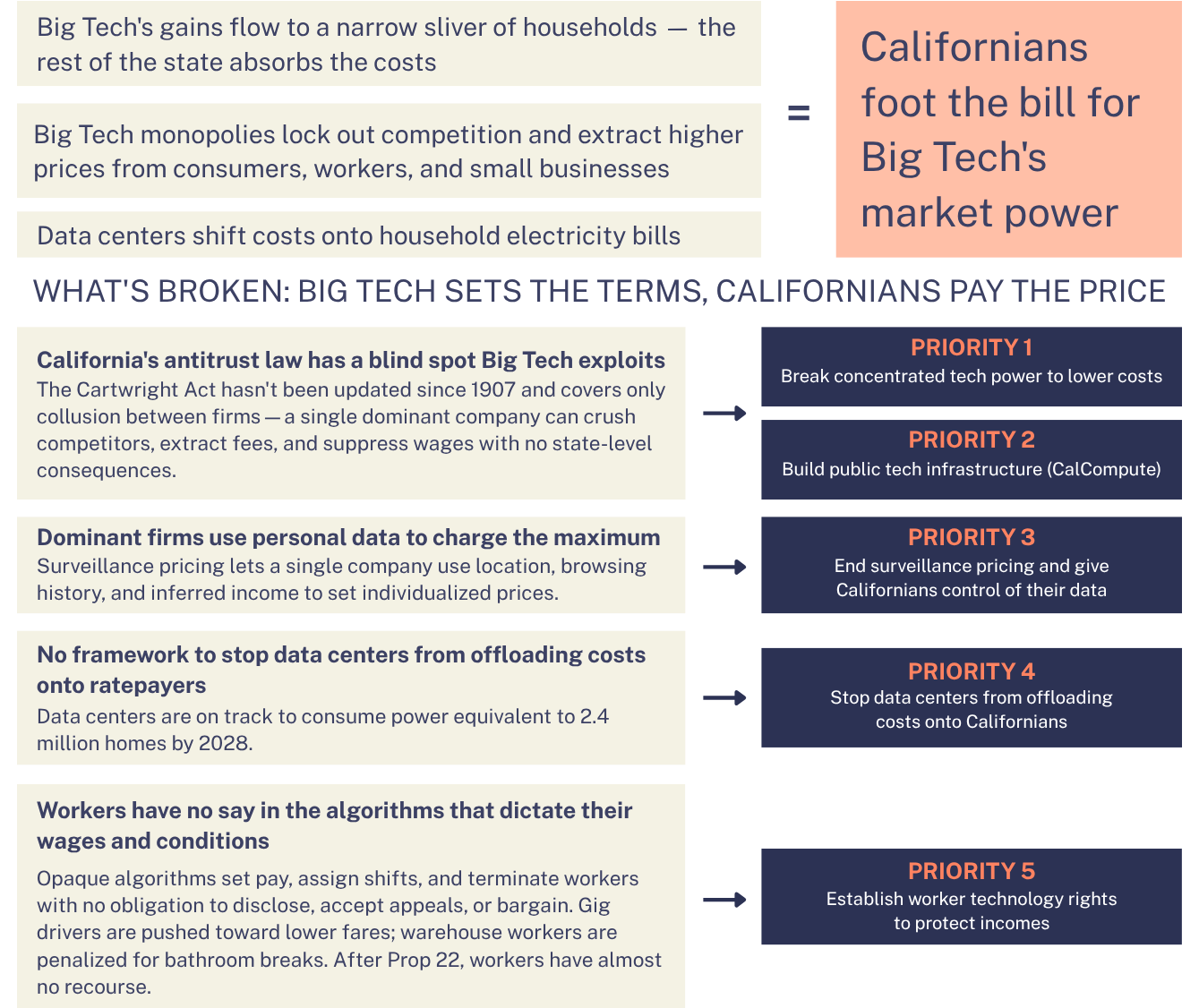
Broken Markets: Big Tech Corporations Are Driving the Affordability Crisis
California’s tech sector is a juggernaut of its economy, but its benefits are extremely lopsided. The sector anchors a tax base that funds California’s schools, roads, and safety net, but those gains are concentrated in a narrow sliver of households and a small cluster of zip codes, while the rest of the state absorbs the costs of Big Tech’s market power. California has the third-largest income gap in the country, with families at the 90th percentile earning 11 times as much as families at the 10th percentile. California corporate profits rose 133% between 2002 and 2022, while typical worker earnings rose 8%. Big Tech sits at the center of that divergence: the same firms capturing those profits are the ones raising household costs.
Big Tech’s market power leaves Californians with little choice about what they pay, because a handful of firms now set the terms for every digital transaction. A generation ago, California’s entrepreneurs, small developers, and independent businesses competed on a more level playing field, driving the innovation that built Silicon Valley and anchored California’s economy. That field has since collapsed into a handful of gatekeepers. Google controls nearly 90% of the search market, forcing small businesses to pay Google to be found by their own customers. Amazon collects at least 45% of every third-party sale from the small businesses on its platform. The same four companies operate 67% of the cloud infrastructure every AI tool depends on, which means every AI product Californians use carries a margin set by the companies that own the servers. Every fee these firms charge flows into everyday costs for consumers. Food delivery platforms charge restaurants 15–30% of every order, and delivery orders cost nearly 80% more than picking up the same meal.
Data centers are driving up electricity bills for California households, and the cost shift is accelerating. From 2022 to 2024, household electricity prices in the United States rose 10% while commercial users, including data centers, saw only a 3% increase. California data centers are on track to consume the equivalent power of 2.4 million homes by 2028, nearly doubling their 2023 load. In Santa Clara, where 60% of the city’s energy now powers data centers, residents saw their 2% annual rate jump to hikes of up to 10% within three years. Households pay these bills because utilities build grid capacity to serve data centers and recover the costs from every ratepayer. Since they have no way to opt out, the same households squeezed by inflated digital fees now carry the data center surcharge as well.
The Affordability Agenda: California, Not Big Tech, Should Decide the Terms of Its Tech Economy
Over the last decade, California has built the country’s strongest portfolio of technology policy covering algorithmic accountability, data privacy, healthcare AI, broadband access, net neutrality, labor protections, and housing affordability. These wins demonstrate that when California sets clear rules and enforces them, Big Tech complies.
What’s Working: California Has Led the Nation in Tech Policy
California has built the nation’s strongest framework against the data exploitation that enables surveillance pricing and predatory targeting. DROP, the data broker deletion platform launched in January 2026 under the Delete Act, lets Californians erase the information brokers hold on them. The Opt Me Out Act will require web browsers to include built-in privacy controls by 2027. California’s Fair Employment and Housing Act regulations, effective October 2025, make the state the first to apply anti-discrimination law to artificial intelligence in hiring, pay, and promotion. Last year, the legislature passed the Preventing Algorithmic Price Fixing Act (AB 325 – Aguiar-Curry), which made it illegal for companies to use shared pricing software to coordinate prices across competitors. Attorney General Bonta followed with a $7 million settlement with Greystar, one of the nation’s largest landlords, restricting its use of competitors’ nonpublic data in rent-setting.
California has invested more than any state in public broadband and public computing. The state’s $6 billion broadband package, passed in 2021, is building an open-access middle-mile network to increase competition and lower consumer prices. The California Public Utilities Commission’s (CPUC) LifeLine broadband pilot brings subsidized internet to an estimated 1.7 million eligible households, filling the gap left by the end of the federal Affordable Connectivity Program. The Transparency in Frontier Artificial Intelligence Act (SB 53 – Wiener) created CalCompute, public computing infrastructure that lets state agencies, researchers, and small businesses access AI without depending on Big Tech cloud providers. To address the household cost side of Big Tech’s infrastructure demands, the legislature also passed the Ratepayer and Technological Protection Act (SB 57 – Padilla ), which requires the CPUC to assess whether data center electricity demand is shifting costs onto residential ratepayers.
What’s Broken: Big Tech Operates Without Accountability, and Californians Pay the Price
California’s antitrust law has a blind spot Big Tech exploits: single-firm monopoly conduct falls outside its reach. California’s main antitrust law, the Cartwright Act, passed in 1907, only covers only collusion between two or more companies. And while it was updated last year to prohibit algorithmic collusion (AB 325 – Aguiar-Curry), the law has never addressed the harms that one individual firm can do on its own. That glaring gap means that a single dominant firm can use its market power to crush competitors, extract fees from businesses, and suppress wages, and the competitors, workers, and consumers harmed have no meaningful recourse under state law.
The results are visible across our economy: Amazon takes at least 45% of every third-party sale from small businesses on its platform, and Apple and Google charge app developers 30% of their revenue just to reach customers. One of the most pernicious abuses is self-preferencing, where tech giants that own digital platforms act as gatekeepers, giving preferential treatment to their own products and services, stifling competition, raising prices for consumers, and growing ever more powerful. Single-firm dominance also shapes what never gets built: investors already refuse to fund startups that might challenge dominant platforms because the outcome is predictable before the competition begins. Some entrepreneurs are skipping the US market entirely, launching abroad because competing against incumbents that control the marketplace is insurmountable. Neither the Cartwright Act nor federal enforcement has kept pace with this conduct, and Californians pay the price as consumers, workers, and would-be competitors.
Dominant firms use algorithms to charge as much as possible, whether by coordinating with competitors or profiling customers individually. Even though California has banned algorithmic price-fixing, a single company acting on its own can still use a customer’s location, browsing history, device type, inferred income, and other personal data to determine the maximum amount a customer will pay. This practice, called “surveillance pricing,” results in grocery stores, retailers, and other sales platforms charging each customer a different price for the same product. When Consumer Reports investigated Instacart’s practices, it found that the platform was charging different customers as much as 23% more for the same item at the same store at the same time, at grocery chains including Safeway, Kroger, and Albertsons. Neither AB 325 nor the Delete Act prevents a company from setting discriminatory prices based on data it collects through its own platforms.
California has no regulatory framework to prevent data centers from shifting costs onto ratepayers, even with buildouts and costs about to spike. PG&E reported a 40% jump in data center grid connection requests in 2025, and projected development in San Jose alone could triple the city’s total energy use. California has no separate rate class for large-load customers, no standardized requirement that data centers cover the grid or water capacity they demand, and subsidies for the industry remain on the books. Other states show the destination of California’s current path: Pennsylvania’s data center growth added an estimated $1.7 billion to ratepayer bills while the industry paid just $1.36 billion in state and local taxes, and Illinois handed out $983 million in tax breaks to data centers, averaging a mere 22 permanent jobs per site.
Workers have no say in the algorithms that dictate their wages and working conditions. Across gig platforms, warehouses, and a growing number of other industries, companies use opaque algorithms to set pay, assign shifts, track productivity, and terminate employees, with no obligation to disclose how the systems work, accept appeals, or bargain over their deployment. Platform algorithms push drivers toward lower fares and longer hours. Warehouse algorithms penalize bathroom breaks as “time off task” and terminate employees for low productivity scores without explanation. When harmed, gig workers have almost nowhere to turn. After the California Supreme Court upheld Proposition 22, the Labor Commissioner determined the office can no longer handle wage claims from drivers classified as independent contractors. The only recourse available is lawsuits brought by local prosecutors or the Attorney General, neither of whom adjudicates individual claims.
What’s Needed: Combatting Algorithmic Extraction
Major players from Silicon Valley are spending more than $39 million to influence California state politics and block tech regulation. California cannot address its affordability crisis without confronting the corporate power behind it. The following five reforms would break Big Tech’s grip on the economy and build towards a technological future that works for all Californians.
PRIORITY 1: Break Concentrated Tech Power to Lower Costs
California needs stronger tools to prosecute tech corporations’ anticompetitive behavior. The rent hikes, surveillance pricing, and exorbitant platform fees will continue as long as dominant firms face no state-level consequences.
Modernize state antitrust law to cover single-firm conduct. The COMPETE Act (AB 1776 – Aguiar-Curry) would give California the authority for the first time to pursue action against a single dominant firm that locks out competitors, whether by paying device makers to exclude rival search engines, forcing app developers to pay a significant portion of their revenue for access to a captive customer base, pricing products below cost to drive competitors off platforms or out of the market, or using dominance to suppress workers’ wages and squeeze suppliers.
Prohibit self-preferencing by the largest digital platforms. The BASED Act (SB 1074 – Wiener) targets the largest digital platforms with a market capitalization of over $1 trillion and 100 million or more U.S. monthly users. The bill would prohibit dominant platforms from burying competitors in search results to prioritize their own products, using private seller data to build knockoff products, barring sellers from offering lower prices elsewhere online, and reserving platform features for their own apps at their competitors’ expense.
Establish data portability and interoperability standards so that Californians and California businesses can move between platforms without losing their data or history.
PRIORITY 2: Build and Fund Public Technology Infrastructure to Break Dependence on Big Tech Cloud Servers
As long as state agencies, researchers, small businesses, and startups depend on Big Tech for computing power, those companies control who builds with AI and who gets priced out.
Fully fund CalCompute’s implementation. CalCompute (SB 53 – Wiener (2025)), housed in the University of California system, would give university researchers and state agencies access to AI computing infrastructure without locking into a single private vendor. With CalCompute, these agencies will be able to build AI tools on infrastructure with transparency and data governance standards that commercial cloud providers have resisted. This implementation can build upon lessons from other successful launches: New York’s Empire AI, a $500 million, ten-year initiative backed by state and philanthropic funding, gave academics access to hardware previously available only to Big Tech and well-funded federal labs.
Design CalCompute to avoid corporate capture. CalCompute’s governance structure, procurement decisions, and data policies must serve the public from the outset rather than create a subsidized pipeline for Big Tech cloud providers. Current federal programs through NSF already subsidize researcher time on Amazon and Google’s own servers, even though buying time on these private clouds costs far more than owning the machines outright. When public computing infrastructure depends on corporate partnerships for hardware, pricing, or governance, the public interest takes a back seat to private profit.
PRIORITY 3: End Surveillance Pricing and Give Californians Control of Their Data
The Surveillance Pricing Protection Act (AB 2564 – Ward) would prohibit businesses from using personal data to charge different consumers different prices for the same goods and services. Existing California law stops companies from coordinating prices through shared software; no statute prevents a single company from using its own data to set individualized prices.
Banning surveillance pricing is necessary, but not sufficient. Consumers also need clear disclosure and meaningful remedies and recourse. AB 2564 allows consumers to go to court to stop a company from using surveillance pricing, but not to recover the money they were overcharged. California should guarantee consumers the right to a refund for any price difference caused by surveillance pricing, allow individuals to sue for per-violation financial penalties, and require disclosure of dynamic pricing algorithms so consumers know when automated systems set the prices they see.
Close the upstream gap that makes surveillance pricing possible in the first place. A company that collects customer location data can still sell it to a broker, who sells it to a third party that builds a pricing profile. California should prohibit the collection and use of location and other sensitive data for pricing or profiling, stop the flow of that data to entities that never obtained consent, and give consumers the right to seek a remedy for any violation. To bolster oversight power, California should also strengthen enforcement of the California Consumer Privacy Act (CCPA) by giving the agency the resources and mandate to proactively audit AI pricing systems.
PRIORITY 4: Stop Data Centers from Offloading Costs onto Californians
California families should not absorb rate hikes to subsidize electricity infrastructure for some of the most profitable companies on earth.
Prohibit tax incentives, cut off subsidies, and ban special economic zones for data center developers. California should not subsidize an industry that takes more from communities than it returns. The legislature should repeal all tax incentives and subsidies for data centers. This includes sales and use-tax exemptions, corporate income tax credits, property tax abatements, and utility tax exemptions.
Make data centers pay the full cost of their energy and water. Data centers should pre-pay 100% of the costs to connect to the electric grid, with minimum contract lengths, minimum demand charges, and early termination penalties to protect ratepayers if a facility closes or uses less power than promised. CPUC should create a separate tariff schedule and rate class for data centers and other large-load customers. The CPUC study mandated by SB 57 will determine whether residential ratepayers subsidize data center electricity costs. If it confirms the subsidy, the legislature should prohibit the practice immediately. The same cost-causation principle should apply to water: a separate utility customer class, with pre-payment for the treatment, storage, and pipeline capacity peak demand requires.
PRIORITY 5: Establish Worker Technology Rights to Protect Incomes
No worker’s pay, safety, or job security should be determined by an algorithm they cannot see, contest, or bargain over. Gig drivers earning below minimum wage and warehouse workers penalized for bathroom breaks share the same problem: an algorithm decides their pay and their discipline, and they have no way to see it, contest it, or bargain over it.”
Ban the most harmful workplace technologies outright: facial recognition, predictive behavioral scoring, productivity monitoring that violates labor or health and safety laws, and algorithmic wage discrimination. Workers should have the right to know what AI systems operate in their workplace, to appeal automated decisions about hiring, firing, and discipline, and to have a meaningful voice before these technologies are deployed.
Build durable guardrails across the gig economy and beyond. California should prohibit employers from using automated systems as the sole basis for discipline or termination, require advance notice before deploying workplace AI tools or executing AI-driven mass layoffs, and mandate impact assessments, individual notification, and human appeal mechanisms for high-risk automated decisions in employment, housing, healthcare, credit, and education.