Press Release
Economic Security Illinois Action Announces NEST Program to Support New Mothers and Improve Birth Outcomes
02. 25. 2026
Direct cash assistance to new moms would reduce preterm births, strengthen families, and save Illinois Medicaid dollars.
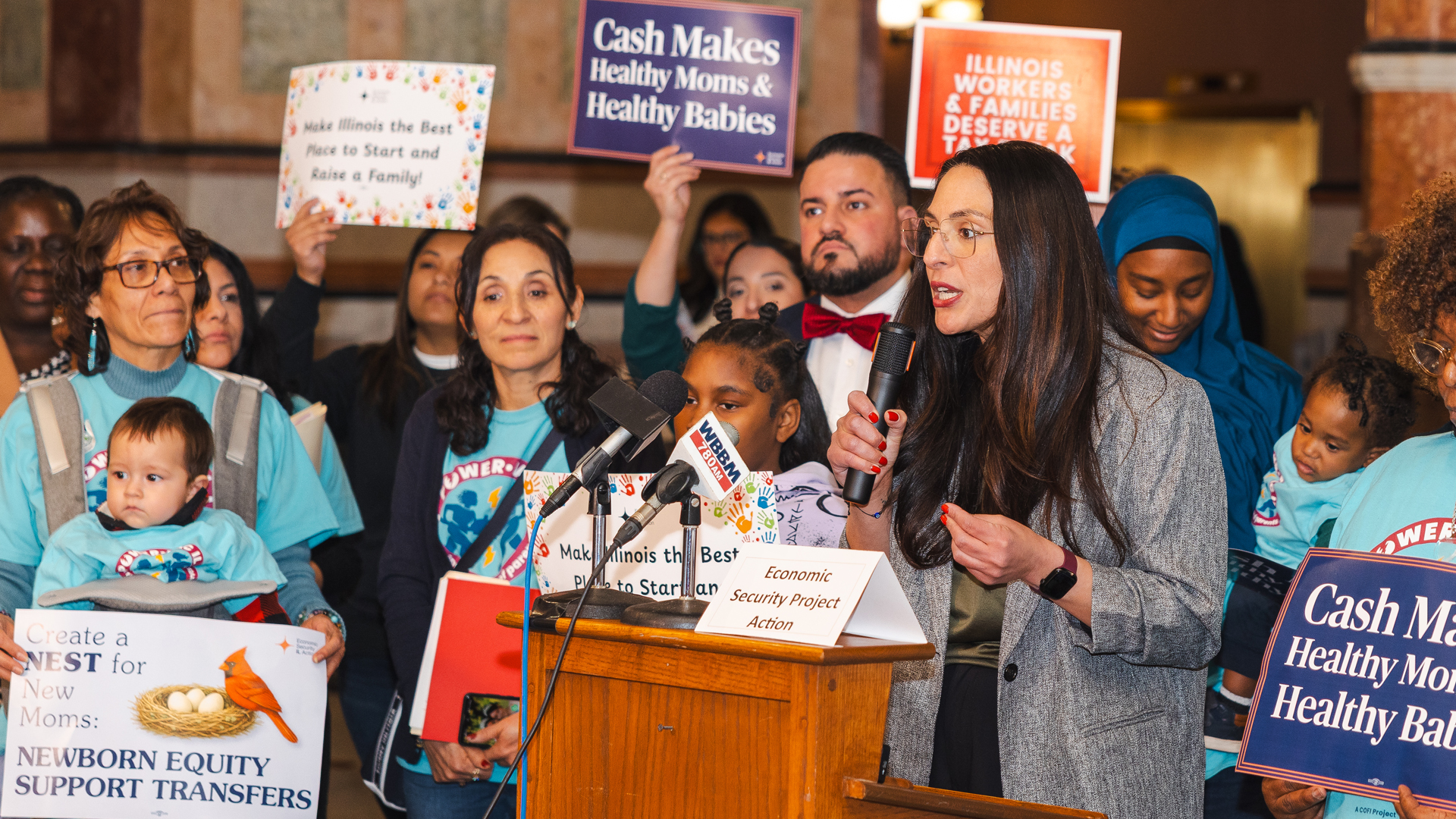
SPRINGFIELD, IL — Economic Security Illinois Action, Senator Graciela Guzman, Representative Kelly Cassidy, and representatives of the Illinois Cost-Of-Living Refund Coalition introduced the Newborn Equity Support Transfer (NEST) program (HB 5238/SB 3756), a bold new proposal designed to improve maternal and infant health outcomes by providing direct financial support to expectant and new mothers on Medicaid. ESIL was joined by legislators, advocates, and parents at a press conference in the Illinois State Capitol rotunda to introduce the proposal.
Modeled after a successful program in Flint, Michigan, NEST is a proven initiative with lifesaving results. Through this model, Flint saw dramatic declines in NICU admissions, pre-term and low-birthweight births, and postpartum depression, while nearly eliminating evictions.
NEST recognizes that the poorest moment in a woman’s life is often at childbirth, contributing to maternal mortality and inequity in birth outcomes. The NEST Program responds to that crisis by offering families stability when it matters most. Under the proposal, eligible mothers would receive $1,500 during the third trimester of pregnancy, followed by $500 per month for the first six months of a baby’s life. Nearly 40 percent of all new mothers in Illinois would be eligible.
“Too many families are forced to navigate pregnancy and early parenthood under crushing financial stress. The result is devastating outcomes for moms and babies,” said Sarah Saheb, Director of Economic Security Illinois Action. “NEST trusts mothers to know what their families need. By putting cash directly in their hands, we can improve birth outcomes, reduce health care costs, and make Illinois the best place in the country to start a family.”
Proven Results From Michigan
NEST is modeled on a successful program launched in Flint, Michigan, which was so effective that it was recently expanded statewide with a $270 million bipartisan investment. The Flint program delivered the following remarkable outcomes per independent research:
- 18% reduction in preterm births
- 27% reduction in low birthweight births
- 29% reduction in NICU admissions
- 32% reduction in maltreatment allegations
- 91% reduction in evictions
- 14% reduction in postpartum depression
- 9.1% increase in prenatal care utilization
New and expectant mothers in Michigan used cash assistance on expenses such as healthcare for the mother or baby, supplemental birth care like doulas, groceries, rent, and childcare. The results mirror other national programs and align with global consensus and years of research. 70% of other countries around the world give money to new mothers, making the United States an outlier among its peers.
“NEST is the next step in our work to address maternal mortality and advance birth equity in Illinois,” said State Senator Graciela Guzman. “This is a proven program that has seen dramatic success in Michigan and countries across the globe. By supporting new mothers when they need it most we can save lives and strengthen our Medicaid program as the Trump administration tries to take us backwards.”
A Smart Investment for Illinois
By reducing costly adverse birth outcomes, NEST is projected to save Illinois over $140 million in Medicaid costs associated with preterm and low-birthweight births. Research shows that costs associated with a preterm birth can exceed $76,000, and low-birthweight births can surpass $100,000 – compared to the cost of a full-term birth at roughly $6,300.
“Healthy babies mean healthier families, stronger communities, and lower costs for everyone,” said State Representative Kelly Cassidy. “NEST is exactly the kind of policy that aligns compassion with fiscal responsibility. In a challenging budget environment, NEST presents a rare opportunity for Illinois to invest in our people and cut Medicaid costs.”
This investment in preventative care and healthier families is all the more critical given that Illinois faces severe maternal care shortages, particularly in downstate communities. According to the March of Dimes, more than one-third of Illinois counties are maternal care deserts. Recognizing the unique needs of Illinois communities, the proposal allows local governments and philanthropic partners to supplement benefits or extend monthly payments beyond six months.
“Nearly three months pregnant, I lost my job, my health insurance, and struggled to qualify for coverage or consistent care under Medicaid,” said Liliana, parent leader with Community Organizing and Family Issues (COFI). “At a time when I needed stability, I was left scrambling to figure out how to see a doctor and protect my own health and the health of my baby. I still hear new parents struggling with the same challenges now– something has to change. That’s why I support NEST because it will help mothers at one of the most important moments in their lives. Every family deserves to experience the joy of bringing a child into this world without crushing stress, and NEST will help make that future possible.”
Child Tax Credit Fix
Building on efforts to support new parents and create opportunity for working families, Economic Security Illinois Action is also pursuing a fix to the state’s Child Tax Credit (CTC) to ensure the lowest-income families can receive the full benefit. As a result of the CTC being tied to federal phase in restrictions, low-income parents who take time off to care for a newborn, work part-time, or pursue education receive a fraction of the credit SB3567, sponsored by Senator Omar Aquino and Representative Mary Beth Canty would decouple the state’s CTC from federal restrictions, ensuring all eligible low-income families receive the full credit.
“I received the Child Tax Credit and it made a real difference for me and my family,” said Mykela Collins, a parent and caregiver from Chicago who advocates with LIFT Chicago and Raising Illinois. “That money helped us pay for utility bills, groceries, and to keep up on rent. My family is on one income a month, so this extra help from the state isn’t extra, it’s essential. I want more families in Illinois to receive that support, especially those who need it most.”
Implemented in fiscal year 2025 and doubled in FY26, the state Child Tax Credit has been an enormous success, providing families with young children up to $600 to help them afford the rising cost of needs like childcare, housing, and education.
“We created the Child Tax Credit to support parents raising young children, helping families across Illinois afford the basics like groceries, rent, child care and school supplies,” said State Senator Omar Aquino. “But too many eligible families are only receiving a fraction of the benefit because of outdated federal income rules that penalize parents. This bill would remove unnecessary barriers so that every eligible family can receive the full benefit they deserve and ensure the program reaches every family it was meant to serve.”
“We are laser focused on the cost-of-living crisis and ensuring our policies reflect the reality families face every day,” said State Representative Mary Beth Canty. “The Child Tax Credit works because it puts cash directly into parents’ hands and trusts them to cover essentials like housing, food, and childcare. Strengthening the credit ensures every eligible family can count on it and build greater financial stability.”
Coalition Comes Together to Tackle Cost of Living Crisis
The Illinois Cost-Of-Living Refund Coalition is leading the advocacy effort for the Newborn Equity Support Transfer (NEST) program and the Child Tax Credit fix. The coalition previously led successful efforts to expand the state’s Earned Income Credit and create and then double the state’s Child Tax Credit. The coalition includes more than 40 nonprofit, labor, consumer advocate, immigrant rights, and grassroots, community-based organizations across the state.