Shaping Markets
The COMPETE Act Will Hold Dominant Food & Ag Firms Accountable for Anticompetitive Conduct that Harms Farmers, Grocers, Workers, & Consumers
04. 03. 2026

The COMPETE Act (AB 1776) would, for the first time, give California a clear statutory prohibition on monopolization, monopsonization, and restraints of trade by a single dominant firm, bringing our state in line with the large majority of states and making it harder for dominant grocery chains, meatpackers, and food distributors to use exclusionary practices, predatory pricing, or buyer power to crush competitors, squeeze farmers, and increase prices.
There’s a concentration crisis in California’s food supply; farmers, workers, and families are paying the price
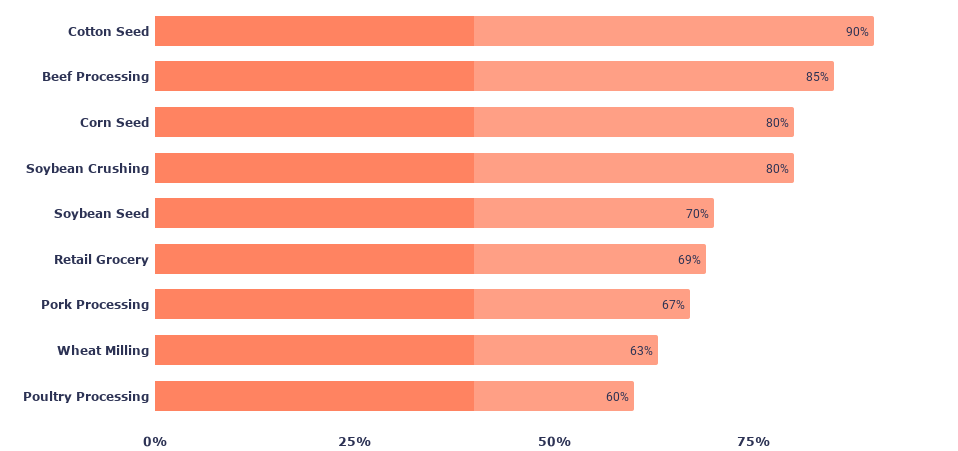
In the past, California’s food economy was defined by competition among a range of meatpackers, regional grocery chains, and independent farmers and distributors vying for business. This competition kept grocery prices in check, gave farmers multiple buyers and workers a choice of employers, and sustained local food economies across the Golden State. Today, four meatpacking giants control 80% of the beef industry; for most grocery items, four or fewer firms control at least 50% of the market. Consolidation of grocery store chains has been so thorough that in many regions, there is a near monopoly by one corporate owner, even though the exterior signage differs. As a result, a handful of food and agriculture and grocery store corporate giants dominate every link of the food supply chain.
FIG. 1. PERCENTAGE OF U.S. MARKET CONTROLLED BY TOP 4 CORPORATIONS
Abuses are likely to occur at 40% of market share.
Without legislation to rein in unchecked anticompetitive conduct by dominant firms, troubling trends will continue:
- Consumers will pay higher prices for groceries, exacerbating the already dire affordability crisis. When a handful of companies control the food supply chain, they can increase their prices without fear of being undercut. During the pandemic, the four largest meatpackers increased their net margins by over 300%, and higher meat prices accounted for 25% of the rise in food prices.
- Ranchers and farmers will continue to be squeezed by fewer buyers for their products. Because a small number of companies control food processing and distribution, producers have limited options: accept the offered price or find nowhere to sell. In 1980, ranchers received 62 cents of every beef dollar; today, they receive just 37 cents.
- Food and grocery workers will continue to see stagnant wages, even as their employers report record profits. When fewer employers compete for workers, wages fall. Kroger and Albertsons employ one quarter of all grocery store workers, yet 78% of Kroger workers are food insecure—seven times the national average.
- Neighborhood grocery stores will continue to disappear, deepening food deserts across California and leaving families facing food insecurity with fewer options. Dominant chains can undercut independents on price, then exit markets entirely by using restrictive deed covenants to prevent competitors from moving in for years. When Safeway closed its downtown Vallejo store, it blocked any grocery stores from taking its place for 15 years. In early 2026, the legislature introduced The Grocery Store Access Act to end this behavior.
The COMPETE Act would restore fair competition by holding single dominant firms accountable for harmful conduct by:
- Closing the single-firm loophole by making it clear that anticompetitive conduct by a monopoly is just as illegal as collusion by multiple companies.
- Holding gatekeepers accountable by prohibiting a single firm from restraining trade, such as when a dominant platform blocks competitors from reaching customers, or uses its power in one market to squeeze out rivals in another.
- Protecting workers and suppliers by explicitly covering monopsony—when a dominant buyer uses its market power to suppress wages or squeeze the businesses that sell to it. When a handful of companies control the market for buying creative work, they can drive down compensation even as their own profits grow.
- Clarifying that California courts are not bound by federal cases that are inconsistent with California’s goal of “maximally” protecting competition, including by enabling courts to take a holistic approach to curbing anticompetitive harm.